CRM Software in South Africa: What Local Teams Actually Need
By Recenvy Team ·
A practical guide to choosing CRM software in South Africa — rand invoicing, VAT, POPIA, local support and why most teams need more than a deal tracker.
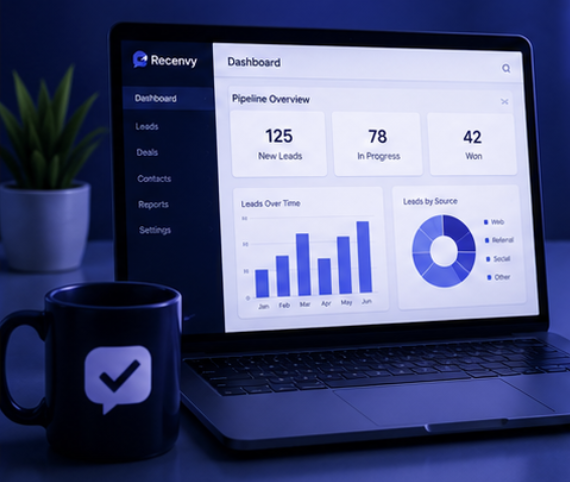
Most South African teams do not have a "CRM problem". They have a coordination problem: an enquiry arrives by email, someone promises a turnaround, a quote goes out in a spreadsheet, the invoice is raised somewhere else, and nobody can answer the simple question where is this now?
Start with the work, not the software category
Before comparing products, write down the flow of one real customer from first contact to money in the bank. For most local organisations it looks like this:
- Enquiry arrives (email, phone, WhatsApp, website form, walk-in)
- It is routed to a person or department with a turnaround commitment
- A quote is issued, revised, and approved
- Work is delivered and recorded
- An invoice is raised in rands, with VAT, and followed up
- Someone reports on all of it at month end
A classic CRM covers step two and three. Everything else usually ends up in email and spreadsheets — which is exactly where accountability disappears.
What "local" should really mean
South African requirements are specific, and they are where imported tools quietly cost you time:
- Rand and VAT handling on quotes, invoices and statements, formatted the way your clients and accountant expect
- Phone number reality — the same person is captured as 082…, 082 …, and +2782…, and search must treat those as one number
- POPIA — personal information stored with role-based access, an audit trail, and a defensible answer to "who saw this record?"
- SAST timestamps so turnaround times and SLA clocks match the working day your team actually works
- Support in your timezone when something breaks on a Monday morning
Questions worth asking any vendor
- Can one system hold enquiries, quotes, invoices, projects and a client portal — or am I buying three tools that must be integrated?
- Can I see, per department, what is open, overdue and unassigned right now?
- Can I restrict what each role sees, down to menus and actions?
- Can clients log in, see their own tickets, quotes, invoices and statements, and stop phoning for updates?
- Can I export my data, and can I audit changes after the fact?
Signs you have outgrown a deal-tracking CRM
You are ready for something broader when the pipeline is tidy but the business still feels chaotic: service requests live in a shared mailbox, approvals are remembered rather than recorded, month-end reporting is a copy-and-paste exercise, and every status update needs a human to chase it.
Recenvy is built for that second problem — one place for stakeholders, enquiries and tickets, quotes and VAT invoicing, projects, and a client portal, with role-based permissions and reporting across all of it.
Related reading: Business Operating System vs CRM and How to choose a CRM in South Africa.
More articles
- About Recenvy: Business Software Built in South Africa — Who we are and what we build: Recenvy is a South African business operating system for stakeholders, enquiries, sales, billing, projects and client portals.
- Why Recenvy: One System for Enquiries, Sales, Delivery and Billing — What Recenvy is, who it is built for, and why South African teams use one platform for stakeholders, helpdesk, quotes, VAT invoicing, projects and a client portal.
- Sales CRM: Running a Pipeline That Tells You the Truth — How to run a sales pipeline that reflects reality: clean stages, one owner per deal, weighted forecasting, and quotes that convert straight into invoices.