Business Operating System vs CRM: Why Your CRM Was Never the Problem
By Recenvy Team ·
A CRM tracks deals. A business operating system runs the whole organisation: enquiries, service delivery, approvals, billing and reporting. Here is the difference and when you need the second one.
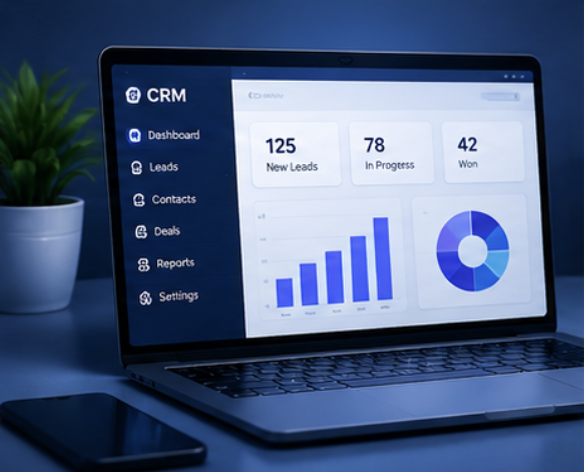
Organisations buy a CRM to fix a sales problem. Six months later the pipeline is tidier and the business is still chaotic. That is not a failed implementation. It is a category mistake.
What a CRM is actually for
A CRM is built around one question: where is this deal? Leads, stages, probabilities, forecasts. It is excellent at that and largely blind to everything after the sale.
What most organisations actually run on
Look at where the working day goes in a SETA, a municipality, a brokerage or a 40-person services firm:
- Enquiries arriving by email, phone, WhatsApp and walk-in
- Requests that need routing to the right department with a turnaround commitment
- Approvals that must be recorded, not remembered
- Projects and tasks with owners and deadlines
- Quotes, invoices, recurring billing and payment follow-up
- Internal IT and facilities requests
- Reporting that management trusts enough to act on
None of that is a deal stage. Most of it happens after the point where a CRM loses interest.
The definition that matters
A business operating system is the single environment where work enters, gets assigned, gets done, gets billed and gets reported. Its organising question is not "where is the deal?" but "where is the work, who owns it, and is it on time?"
| Dimension | CRM | Business OS |
|---|---|---|
| Core object | Deal | Work item and stakeholder |
| Ends at | Closed-won | Delivered, billed, reported |
| Owner | Sales | Whole organisation |
| Success metric | Conversion rate | Turnaround time and throughput |
| Failure mode | Stale pipeline | Dropped request |
Three symptoms you have outgrown a CRM
- The handover gap. Sales closes it, delivery never hears about it, and the client chases both.
- Spreadsheet gravity. Every department maintains a private tracker because the CRM does not fit their work.
- Reporting by interrogation. Monthly numbers are assembled by asking people, not by running a report.
What changes when you consolidate
When enquiries, service delivery, billing and internal requests share one data layer, three things become possible that no amount of CRM configuration delivers:
- One stakeholder history. Every call, ticket, quote, invoice and contract in one timeline.
- Real turnaround measurement. Because the clock starts when the enquiry lands, not when someone remembers to log it.
- Accountability without meetings. Every item has an owner and a due date, visible to the person responsible for the outcome.
Where Recenvy sits
Recenvy was built as an operating system rather than a sales tool. Stakeholder management, helpdesk with SLAs, projects and tasks, quotes and invoicing, contracts with digital signatures, an internal ICT helpdesk, customer portals and a custom report builder run on one governed database with role-based access.
Your CRM was never the problem. It was just answering a smaller question than the one your organisation is asking.
More articles
- About Recenvy: Business Software Built in South Africa — Who we are and what we build: Recenvy is a South African business operating system for stakeholders, enquiries, sales, billing, projects and client portals.
- CRM Software in South Africa: What Local Teams Actually Need — A practical guide to choosing CRM software in South Africa — rand invoicing, VAT, POPIA, local support and why most teams need more than a deal tracker.
- Why Recenvy: One System for Enquiries, Sales, Delivery and Billing — What Recenvy is, who it is built for, and why South African teams use one platform for stakeholders, helpdesk, quotes, VAT invoicing, projects and a client portal.