Nine Tools, One Business: The Real Cost of a Patchwork System
By Recenvy Team ·
Spreadsheets, a CRM, an invoicing app, a shared inbox and WhatsApp. Here is what a fragmented tool stack costs South African organisations, and how to consolidate without a risky big-bang migration.
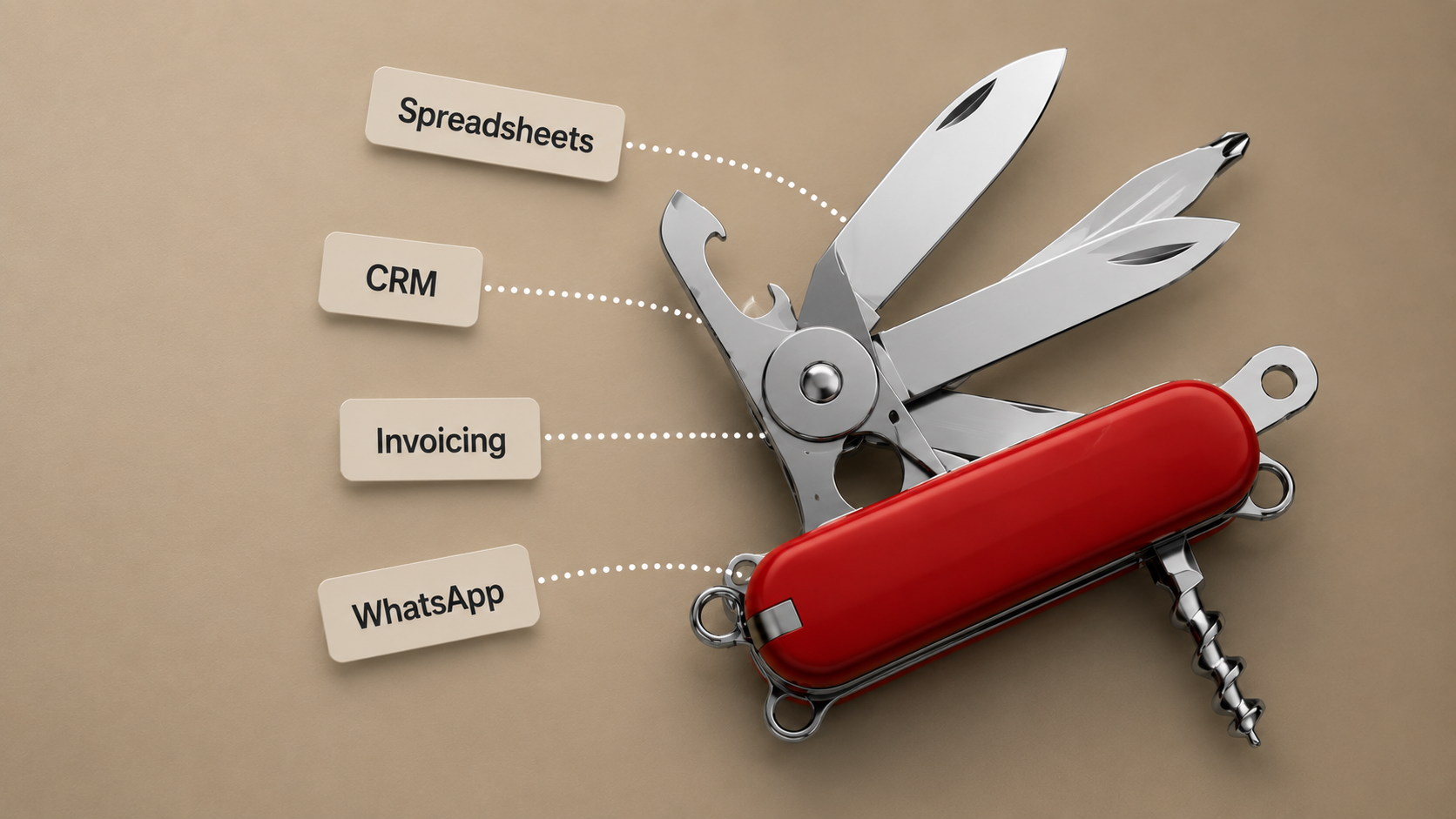
Count the systems your organisation touches in a normal week. Most organisations we meet reach nine before they finish: a spreadsheet for the master list, a CRM nobody updates, an invoicing app, a shared inbox, WhatsApp groups, a file share, a separate quoting template, a project tracker and a payroll portal.
Each was a sensible decision. Together they are the reason nothing reconciles.
The four hidden costs
1. Re-entry
The same client name typed into four systems. Every re-entry is a chance to create a second version of the truth, and a second version of the truth is why two departments quote different numbers to the same client.
2. Reconciliation time
Month-end becomes an exercise in matching lists. Skilled staff spend days doing work that produces no output beyond agreement about what already happened.
3. Invisible work
Anything living in a personal inbox or a WhatsApp thread does not exist to the organisation. It cannot be assigned, measured, escalated or handed over. It disappears when someone resigns.
4. Governance gaps
Nine systems mean nine access lists, nine offboarding steps and nine places personal information sits. Under POPIA, the tool count is the risk surface.
What consolidation should mean
Consolidation is not "one app for everything". It is one system of record for stakeholders and work, with everything else feeding into it. The test is a single question: if you open a stakeholder record, can you see their contacts, requests, quotes, invoices, documents and full interaction history without leaving the screen?
How to consolidate without breaking the business
- Start with the stakeholder register. Import the master list, deduplicate it, and make it the only place new stakeholders are created. Nothing else works until this is settled.
- Move inbound next. Route the shared inbox and the web forms into a ticketed queue. This produces visible relief in the first week and builds trust in the new system.
- Then quotes and invoices. Once stakeholders are clean, billing on top of them is straightforward, and it links revenue to the relationship.
- Then internal work. Projects, tasks, internal IT requests and approvals.
- Retire deliberately. Each old tool gets a switch-off date and a read-only archive. Systems that are "still there just in case" never die.
Run the sequence over weeks, not in one weekend. Big-bang migrations fail for a mundane reason: staff revert to the tool they trust the moment they are under pressure.
What good looks like afterwards
- One stakeholder record with a complete timeline
- One queue where every request has an owner and a due date
- One place quotes become invoices become payments
- One access list, one offboarding step, one audit log
- Reports that come from records rather than from asking people
Recenvy is built for exactly this consolidation: stakeholders, helpdesk, projects, quotes and invoicing, contracts, internal ICT requests, portals and reporting on one governed platform, with CSV import tools to bring the old lists in and role-based access to keep them safe.
More articles
- About Recenvy: Business Software Built in South Africa — Who we are and what we build: Recenvy is a South African business operating system for stakeholders, enquiries, sales, billing, projects and client portals.
- CRM Software in South Africa: What Local Teams Actually Need — A practical guide to choosing CRM software in South Africa — rand invoicing, VAT, POPIA, local support and why most teams need more than a deal tracker.
- Why Recenvy: One System for Enquiries, Sales, Delivery and Billing — What Recenvy is, who it is built for, and why South African teams use one platform for stakeholders, helpdesk, quotes, VAT invoicing, projects and a client portal.